BoxBrownie vs AI Virtual Staging Tools (2026 Review)
BoxBrownie charges $30/image (verified July 2026) with 2 months of unlimited revisions; AI tools run ~$0.24–2.70. An honest look at when each wins.
By Derek Li · Updated October 11, 2026 · 12 min read
BoxBrownie virtual staging costs US$30 per image, arrives in under 48 hours, and includes unlimited changes at no extra cost for two months. AI staging tools cost $14–99 per month — roughly $0.24 to $2.70 per image depending on plan — and render in seconds, with failure modes this review describes in detail instead of waving away. That asymmetry is the whole verdict: for a single hero listing, $30 with a human who revises until it's right is a rational buy; for twenty photos a month, the same work costs $600 at BoxBrownie against a $19–29 subscription, and the decision stops being close. Every BoxBrownie figure below was checked on boxbrownie.com on July 12, 2026, because a surprising amount of what circulates in other comparisons is stale. (Disclosure: roompano, which runs this site, is an AI staging tool — one side of this comparison. That's exactly why BoxBrownie's strengths get stated in full here: the contrast only means something if both halves are accurate.)
What BoxBrownie virtual staging costs in 2026 (verified)
Start with the number other comparisons get wrong. Articles still in circulation quote US$24 per staged image. That figure is years out of date — its likely source is a 2021 commercial-staging promotion still live on BoxBrownie's blog. The current rate is US$30 per image, and BoxBrownie's own price-drop page displays it as "US$30 WAS US$40." Commercial staging fell harder — non-office commercial spaces were US$100, offices US$60, and everything now sits at the same flat US$30.
The full menu, as of July 12, 2026:
| Service | Current price | Previous price |
|---|---|---|
| Virtual staging (residential) | US$30/image | US$40 |
| Virtual staging (commercial, non-office) | US$30/image | US$100 |
| Virtual staging (office) | US$30/image | US$60 |
| 360° virtual staging | US$60/image | — |
| Image enhancement | US$2 (US$5 for 360°) | — |
| Day to dusk | US$5 | — |
| Item removal | US$5–10 | — |
| Color change | US$3 | — |
| Floor plan redraw | US$30–40 | — |
| CGI renders | from US$350 | — |
Source: boxbrownie.com pricing and price-drop pages, checked July 12, 2026.
Before your first upload, know how the service is built. There's no subscription — everything is pay-as-you-go, which for an agent who stages a handful of photos a year is a genuine advantage over software that bills monthly whether you list or not. Source photos must be high resolution (over 1MB), so a compressed phone shot pulled from an old listing may get bounced back. And there is no free staging trial: the first dollar you spend on BoxBrownie staging is thirty of them. The flip side of pay-as-you-go is that the price is per image with no monthly allowance — your twentieth staged photo costs the same $30 as your first, which is exactly where the comparison with subscription software starts to bite.
Turnaround is quoted at under 48 hours for virtual staging and 24 hours for most other edits, with support available around the clock. For how these numbers sit within the wider market, the virtual staging cost guide has the full breakdown.
Where BoxBrownie is genuinely better
Hard photos, first. The scenes where AI staging fails most often — awkward room geometry, spaces still full of the previous owner's belongings, mirrors and glass throwing reflections — are ordinary work for a human editor. If your listing photos are difficult, the gap between a $30 human edit and a fifty-cent AI render is visible to anyone who looks.
The revision policy deserves an accurate description, because comparison articles routinely shortchange it: unlimited changes at no extra cost within two months of the original job. Not one included revision round — unlimited, for two months. For a photo that will front a listing's entire marketing run, that policy turns $30 from a gamble into a fixed price for "done right." It is, in our reading, the single strongest reason to choose a human service, and it deserves to be quoted correctly.
Consistency across a listing matters more than most rankings admit. A human editor stages your five living-room angles with the same sofa in the same place. Most AI tools still can't do that reliably across a photo set, and a listing where the furniture quietly changes between photos reads worse than an empty one.
Then there's breadth. BoxBrownie stages 360° panoramas at US$60 per image — a rare capability, since most AI tools don't stage panoramas at all — and the same account covers floor plan redraws ($30–40), CGI renders (from $350), day-to-dusk conversions, item removal, and color changes. One vendor for the whole listing-photo pipeline is a real operational argument. Staging comes in nine furniture styles (Modern, Contemporary, Farmhouse, Traditional, Urban-Industrial, Mid-Century Modern, Hamptons, Commercial, Scandinavian), which covers most briefs an agent will ever write.
The reputation holds up under inspection, too. We mined BoxBrownie's Trustpilot profile in July 2026: 345 reviews, averaging 4.6/5. Of 100 reviews we sampled, 58 mention "fast" — notable for a service that quotes 48 hours, and a sign it routinely beats its own promise. The free-revision policy is praised again and again. Add the franchise client roster (RE/MAX, Keller Williams, Sotheby's, CBRE) and steady press coverage, and this is about as solid as a reputation gets in this niche.
Where AI tools win
Price and speed, by roughly two orders of magnitude each — boring, but decisive. An AI render takes seconds to a couple of minutes; BoxBrownie quotes up to 48 hours. Subscriptions run $14–99 a month, which works out to roughly $0.24–2.70 per image depending on plan: Virtual Staging AI at $16/month for 6 photos, Collov at $19 for 60 credits, Pedra at €29 for 100 credits, roompano at €19 for 40 rooms (ours — see the disclosure above). Those figures were verified on official pricing pages on July 8, 2026, and the full 8-tool comparison table breaks them down further.
Speed at that scale changes the workflow itself. When a render takes seconds, staging happens while you're still culling the shoot, and an angle that stages badly can be re-shot the same day; a two-day loop forecloses all of that.
Variants are the underrated half of the value. Most subscriptions include unlimited regenerations, so you can render the same room Scandinavian, then Mid-Century, then Farmhouse before BoxBrownie's queue has acknowledged your job. When you're unsure what a buyer demographic responds to, cheap variants become a testing tool that a fixed $30, single-style order can't be.
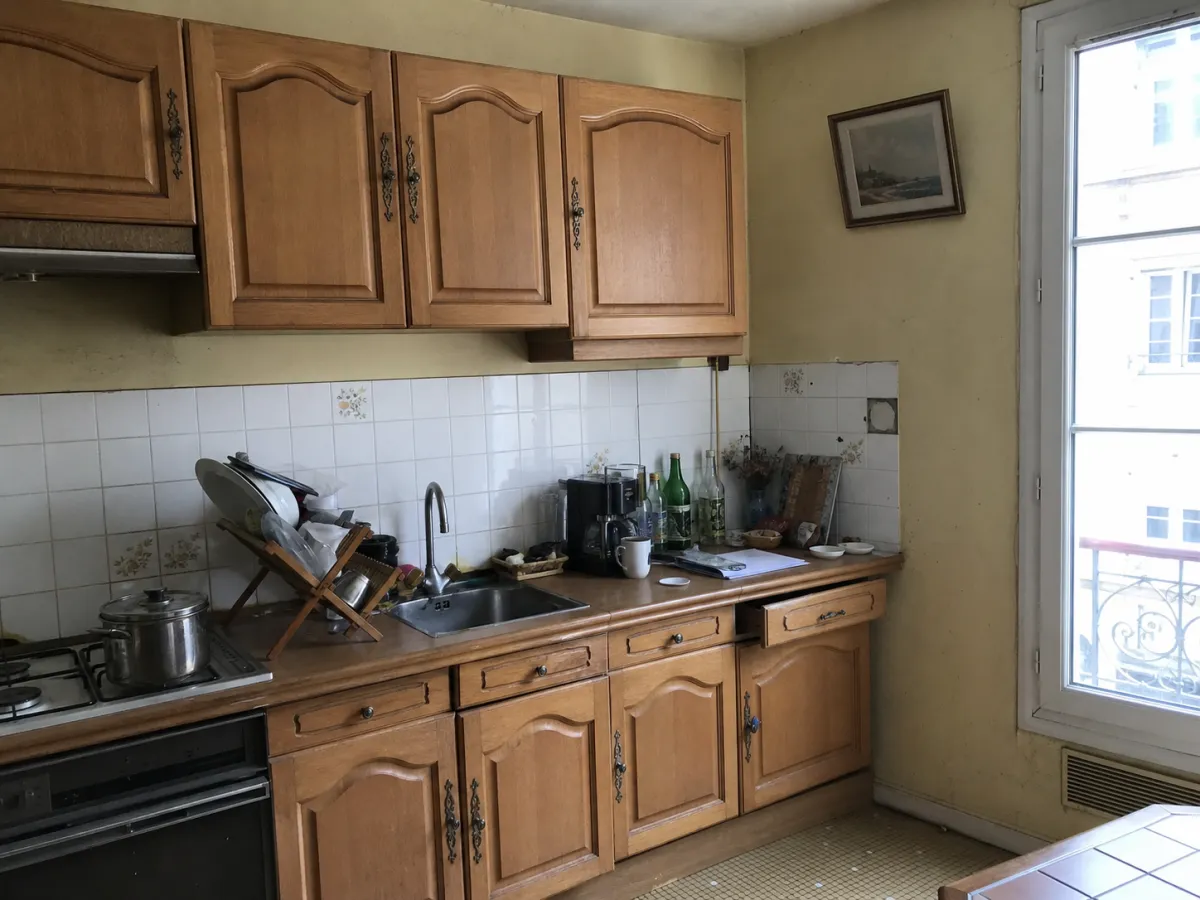 Before: AI-generated illustration
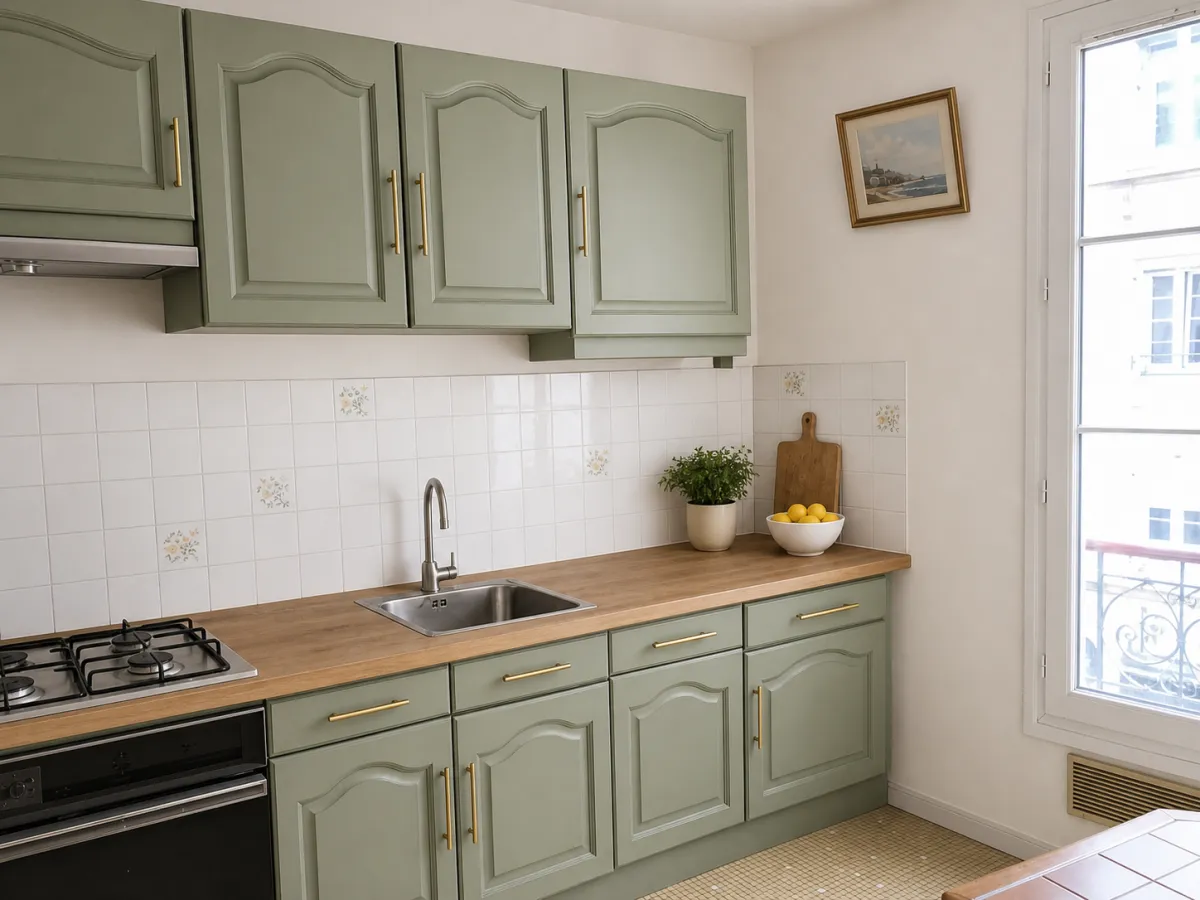 Variant one: sage green cabinets
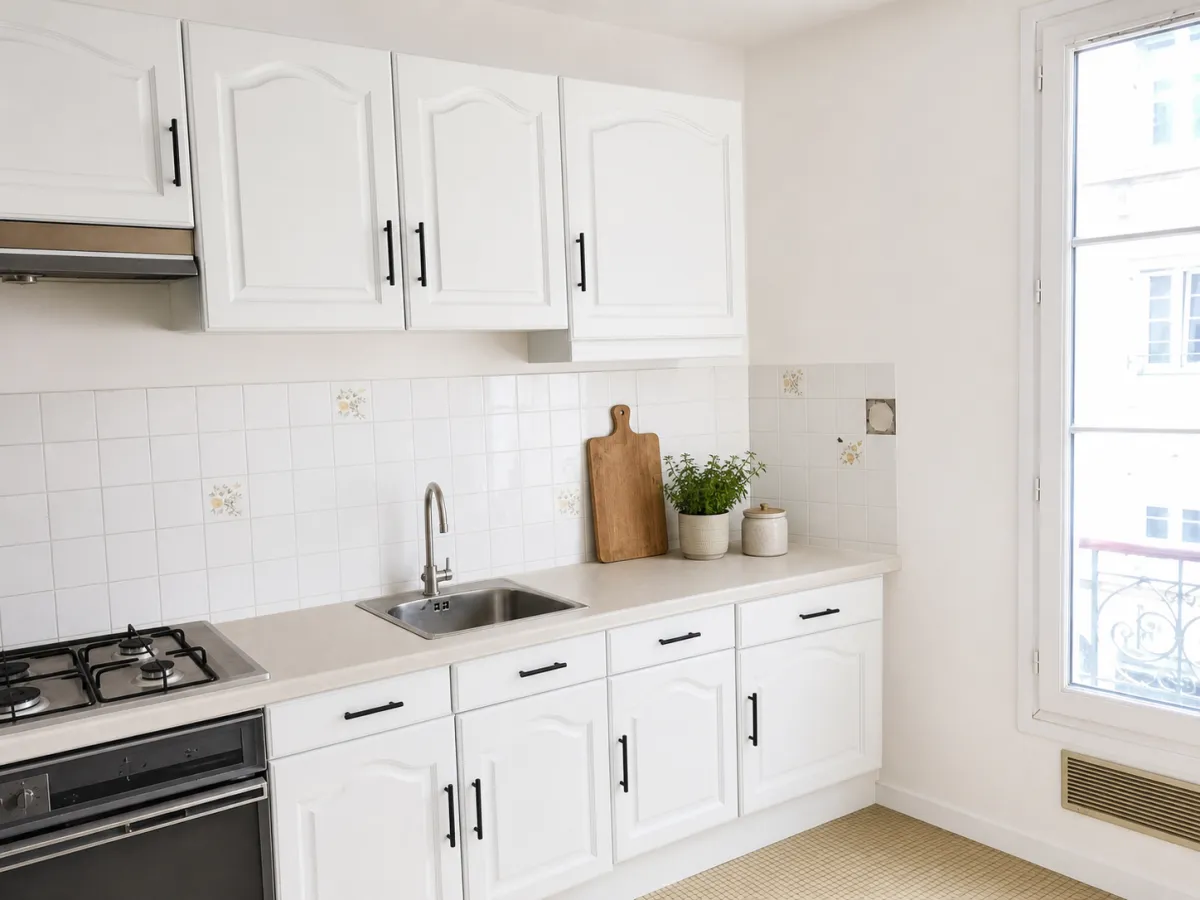 Variant two, same photo: matte white. Two styles cost one credit each, not two $30 orders
The same goes for kitchens, where an AI kitchen design run can test cabinet colors that a human editor would quote separately.
The volume math does the rest. Twenty photos in a month is a normal load for an active agent: $600 at BoxBrownie, $19–29 on a subscription that actually covers twenty photos. No quality argument closes a 20–32× price gap by itself — and if most of your photos are ordinary empty rooms shot in decent light, the human premium buys polish most portal browsers will never consciously register.
There is also a market signal worth reading in BoxBrownie's own numbers. Its price-drop page announces staging down from $40 to $30, and commercial staging down from as much as $100, with no stated reason. Cuts of that size — 25% on residential, 70% on commercial — are not cosmetic. Our inference — ours explicitly, BoxBrownie says nothing of the kind — is that sub-dollar AI staging has reset what the market will pay for a furnished photo. The review mining adds a data point, singular but pointed: in May 2026, an unprompted Trustpilot review describes running the same rooms through a general-purpose AI chatbot and preferring the free result. Treat that as a signal, not a verdict — one review is one review, chatbot output is rarely listing-grade, and 4.6/5 remains an excellent score. But when a human service's own customer reviews start naming free AI as the alternative, the direction of pricing pressure isn't mysterious.
Where AI tools honestly fail
Structure drift is the big one. The top complaint about AI staging in agent communities isn't ugly furniture; it's tools that add a window, delete a radiator, or straighten a wall that was never straight. On an MLS listing, an invented window is a misrepresentation that survives until a buyer stands in the room and asks where it went. A human editor doesn't invent windows. This is also why staged photos need labeling wherever you publish them — the disclosure guide covers the rules by region, and they are stricter than most agents assume.
Multi-photo consistency is the mirror image of the human strength above: rendering the same furniture across a whole listing's photo set is still unreliable on most AI tools. For one hero image this doesn't matter. For a twelve-photo listing, it can.
Complex scenes fail more often, and the failure rate climbs exactly where you'd most want help — heavy clutter, unusual layouts, strong reflections. AI staging is at its best on the empty, well-lit, rectangular room. So, admittedly, is everything else.
And there's no human backstop. When a render comes out nearly right — good sofa, wrong rug — nobody fixes that render. You regenerate and hope the next roll keeps what was good. Unlimited regenerations soften the pain, and on easy rooms a re-roll takes ten seconds; on hard rooms it's the difference between iterating toward a result and gambling toward one. BoxBrownie's two-month revision window is the opposite operating model, and it's the strongest argument for paying thirty dollars instead of thirty cents.
Where does roompano sit in all this? Structure drift is the failure we built against: the AI furnishes the room without renovating it, by design. Every export also carries an automatic "virtually staged" label plus C2PA content credentials, which is designed to take the disclosure step off your checklist rather than leave it to memory. Complex scenes remain genuinely hard for us too, and there is still no human in the loop. Anyone selling you AI staging without those caveats is selling.
Choose BoxBrownie if… / choose an AI tool if…
In practice the decision collapses to two variables: how many photos you stage, and how difficult they are. Both lists assume the July 2026 prices above.
Choose BoxBrownie if:
- One hero shot carries the listing's marketing and $30 is a rounding error against the commission.
- The photos are hard: cluttered rooms, mirrors everywhere, geometry that confuses algorithms.
- You want finished files from a human, backed by two months of free changes, and 48 hours is fast enough.
- You shoot 360° panoramas and want them staged — at US$60/image, a service most AI tools simply don't offer. (roompano approaches 360 differently, reconstructing a tour from ordinary phone photos, but staging an existing panorama remains a human specialty.)
Choose an AI tool if:
- You stage in volume — at twenty photos a month the gap is $600 versus $19–29.
- Photos need to be live before the weekend's viewings, and a 48-hour queue is two days too long.
- You want to test several furnishing styles per photo and let the listing data decide.
- You want disclosure labeling handled in the export rather than remembered by a busy human.
And then there's the option the "versus" framing hides: use both. Send the one hero photo of a major listing to BoxBrownie at $30, with its revision safety net; run the other nineteen photos through a subscription for pocket change. That month costs roughly $49–59 in total — human quality where buyers look longest, AI economics everywhere else. Plenty of working agents describe exactly this pattern, and there is nothing incoherent about it.
Frequently asked questions
How much does BoxBrownie virtual staging cost?
US$30 per image for residential and commercial staging alike, verified on boxbrownie.com on July 12, 2026 — down from US$40 (commercial spaces previously cost up to US$100). 360° staging is US$60 per image. It's pay-as-you-go with no subscription and no free staging trial. Comparison articles quoting US$24 are out of date.
How long does BoxBrownie take?
Under 48 hours for virtual staging; most other edits, like image enhancement and day-to-dusk, are quoted at 24 hours, with 24/7 support. Revisions are free within two months of the original job but travel through the same queue, so budget a few days for a full revision loop — quick for a human service, slow next to an AI render measured in seconds.
Is BoxBrownie worth it vs AI staging?
For one important image, often yes: $30 buys human handling of difficult scenes plus unlimited changes for two months. As a default pipeline it's harder to justify — twenty photos cost $600 versus $19–29 for a month of an AI subscription. Volume decides, and if your listing photos are consistently difficult the human premium earns its keep sooner. The hybrid (human service for the hero shot, AI for the rest) is a legitimate answer rather than a cop-out.
Does BoxBrownie use AI?
Its website markets human photo editing and lists no AI staging product. Some third-party reviewers speculate that AI assists parts of its internal workflow; BoxBrownie itself says nothing of the sort, so treat that as speculation. Either way, what you're paying for is output a person has checked and will revise on request — that's the actual product.
The $30 test
Take the hardest photo from your current listings — the cluttered lounge, or the bedroom with the mirrored wardrobe. Send it to BoxBrownie for $30, and run it through an AI tool's free tier the same afternoon (roompano's covers 2 rooms, no card required). Two days later you'll have both results, on your own photo, for the price of a lunch — and a far better answer than any review can give you about which side of this comparison your business belongs on.