Virtual Staging Cost in 2026: Real Prices, Compared
Virtual staging costs $0.24–$2.70 per image with AI tools, $16–30 with human editors. Verified July 2026 prices, per-image math, and the hidden fees.
By Julien Garnier · Updated October 11, 2026 · 12 min read
AI virtual staging runs $0.24–$2.70 per image on subscriptions of $14–99 per month; human done-for-you services charge $16–30 per image; and physically staging a vacant home averages $4,000–6,000. That's the direct answer to "how much does virtual staging cost" — and it's the last vague range you'll read on this page. What follows: named tools with prices verified on each vendor's official pricing page in July 2026, the per-image math those pages carefully avoid doing for you, and the hidden fees that decide whether a $19 plan stays a $19 plan. (Disclosure: roompano, which runs this site, is one of the tools priced below — its numbers sit in the table under the same rules as everyone else's.)
The virtual staging cost table (verified July 2026)
Effective cost per image is the column no pricing page publishes, because subscriptions hide it. A $16 plan sounds cheaper than a $19 plan until you notice the first covers 6 photos and the second covers 60. Divide the monthly price by the included volume and the ranking reshuffles completely.
| Tool | Model | Entry price | Effective cost per image | Verified |
|---|---|---|---|---|
| Pedra | AI subscription (credits) | €29/mo · 100 credits | ≈€0.29 per credit; videos & 360 tours don't consume credits | Jul 8, 2026 |
| Collov AI | AI subscription + overage | $19/mo · 60 credits | ≈$0.32 ($0.24 per extra image) | Jul 8, 2026 |
| roompano (ours) | AI subscription (rooms) | €19/mo · 40 rooms | ≈€0.48 per room; 360 tours from phone photos included | Jul 8, 2026 |
| Virtual Staging AI (Zillow) | AI subscription (photos) | $16/mo · 6 photos, up to $79/mo · 150 | ≈$0.53–2.67 depending on tier | Jul 8, 2026 |
| REimagineHome | AI subscription | $14–99/mo | can't compute — mid-tier volumes not published on the official page | Jul 8, 2026 |
| Apply Design | Pay per image (coins) | no subscription | ≈$10.50–15 auto-staged; 360 ≈$17.50–25 | Jul 8, 2026 |
| Styldod | Human, per image | $23/image | $23, dropping to $16 at 8+ images | Jul 8, 2026 |
| BoxBrownie | Human, per image | $30/image | $30 flat; 360 staging $60 | Jul 12, 2026 |
Sources: official pricing pages — Virtual Staging AI, Collov, REimagineHome, Apply Design, Pedra, Styldod, BoxBrownie, roompano.
Three things the table teaches that a headline price hides. First, the cheapest sticker is the most expensive photo: Virtual Staging AI's $16 entry plan works out to $2.67 per image, five times its own $79 tier ($0.53) and eleven times Collov's $0.24 overage rate. Second, one vendor simply doesn't let you do the division — REimagineHome's official page shows $14–99 a month without publishing what the middle tiers include, so we won't quote numbers we couldn't verify. Third, the gap between software and humans is a full order of magnitude: the priciest AI render in this table (~$15 at Apply Design) still undercuts the cheapest human edit ($16 at Styldod's bulk rate). Feature-by-feature detail on all eight tools lives in our full comparison; this page stays on money.
What a full listing actually costs
A typical listing stages 4–6 photos — living room, kitchen, primary bedroom, and one or two more. Bathrooms, hallways and exteriors rarely need furniture; the money shots are the rooms where a buyer has to imagine their own sofa. That's not a guess: Stuccco, a human staging provider, reports its average order is exactly 6 photos, at $204. So run the 6-photo scenario down all three paths, using only the verified prices above.
Path 1 — AI subscription: $16–29 total. Virtual Staging AI's $16 entry plan covers exactly 6 photos, so one listing costs one month. Collov's $19 buys 60 credits — that's ten listings, or $1.90 per listing if you actually use them. roompano's €19 covers 40 rooms; Pedra's €29 covers 100 credits. The pattern: your first listing costs the subscription, and every additional listing that month costs almost nothing.
Path 2 — human per-image: $138–204. Styldod charges 6 × $23 = $138 (its $16 bulk rate starts at 8 images, so a standard 6-photo order doesn't qualify — a detail worth knowing before you assume the discount). BoxBrownie runs 6 × $30 = $180. Stuccco's self-reported $204 average order lands right at the top of that band, which suggests these numbers describe the real market, not cherry-picked entry rates.
Path 3 — physical staging: $150 before a single sofa arrives. Zillow, citing Thumbtack data, puts the initial consultation alone at $150–600. Staging an occupied home runs $1,000–3,000+; a vacant home runs $4,000–6,000+, and vacant-home staging is often billed monthly for as long as the listing sits.
Time is the fourth price. AI renders arrive in minutes; both human services quote 24–48 hours; physical staging means scheduling a consultation, a furniture delivery, and a pickup. If your seller signs on Thursday and the photographer comes Friday, two of these three paths are already closed.
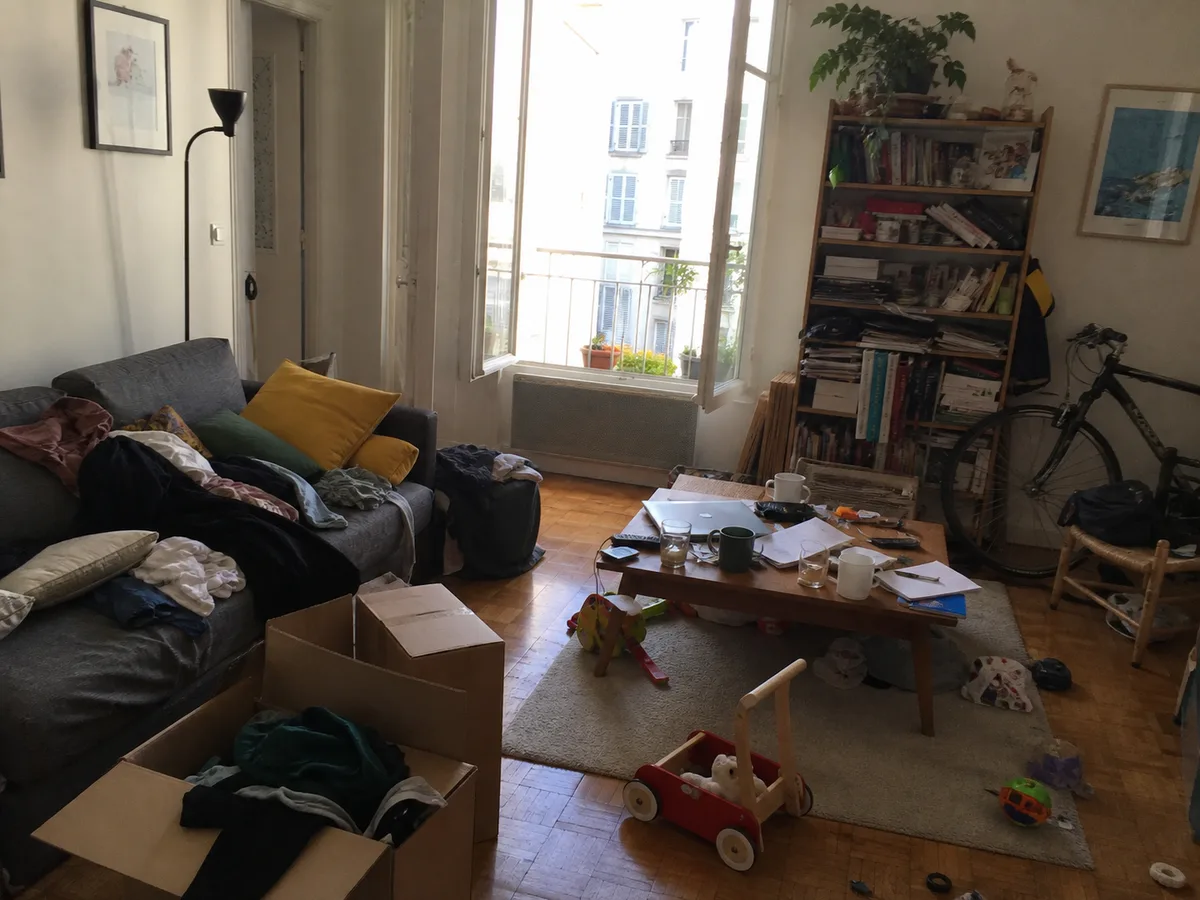 Before: an occupied home, the case physical staging bills $1,000–3,000+ for (AI-generated illustration)
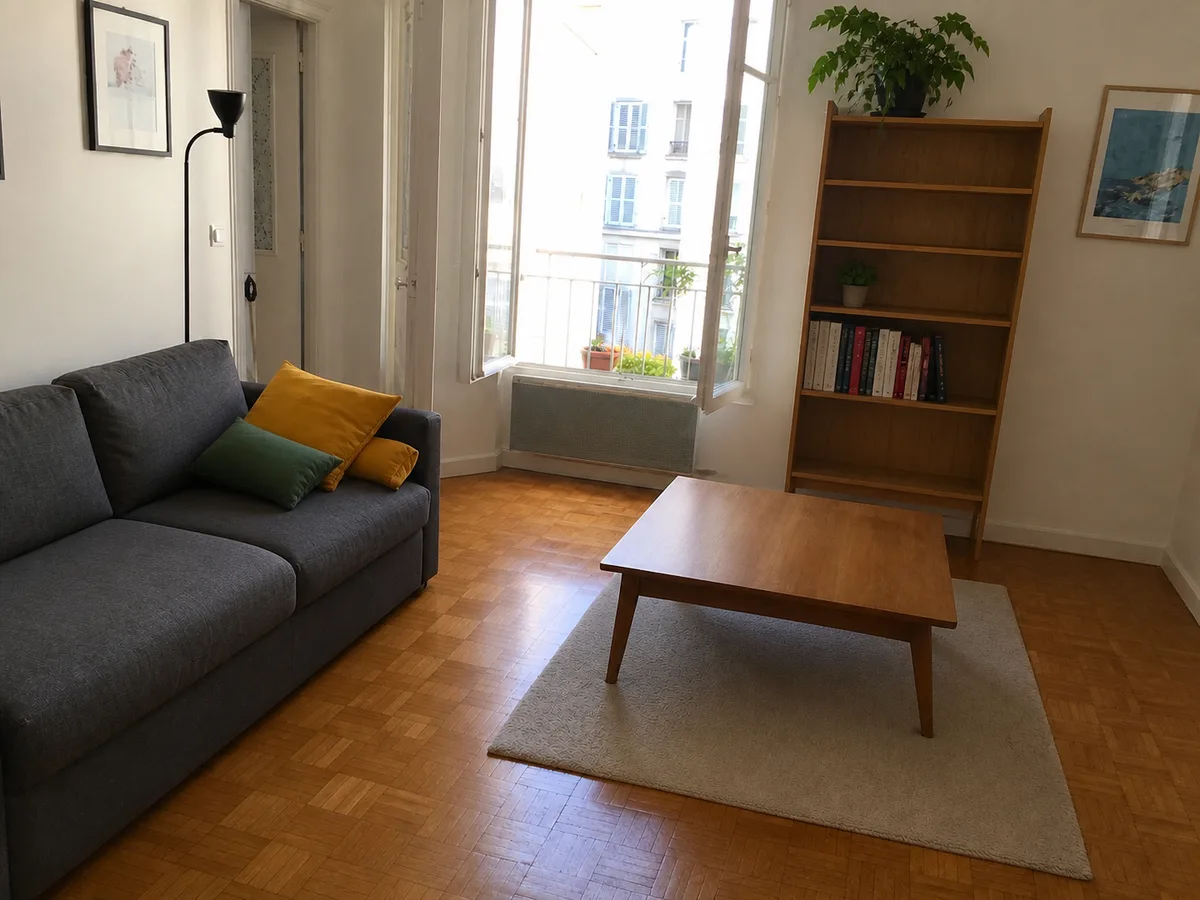 After: decluttered virtually, for one credit
The hidden costs nobody itemizes
Every pricing page above is accurate. None of them is complete. These are the six line items we've learned to check before trusting any per-image math — our own included.
Credits that expire. Most staging subscriptions reset monthly with no rollover. That $0.32-per-image rate on a 60-credit plan assumes you stage 60 images; stage 12 in a slow month and your real cost was $1.58 each. Match the plan to your actual monthly volume, not your best month.
The annual-billing asterisk. A common industry pattern: the big advertised monthly number is the annual-commitment rate, and the true month-to-month price sits behind a toggle, higher. Before comparing two tools, make sure both toggles are set to the same billing period — otherwise you're comparing a 12-month promise against a monthly one.
Watermark and resolution paywalls. Free tiers exist to let you judge quality, and for that they're genuinely useful — we keep a whole guide to testing without paying. But publishable output is the paid product: trials commonly watermark the render or cap the resolution below what an MLS hero image needs. Budget for the paid tier from day one; the free tier is an audition, a fact worth internalizing before you promise a seller staged photos by Friday on a $0 plan.
Per-room vs per-photo billing. Some services meter by visible room rather than by photo — an open-plan kitchen-living shot can count as two. On a listing full of open-plan angles, that quietly doubles the bill. One question to support ("is an open-plan photo one credit or two?") settles it before you upload.
Revision fees. Human services include a set number of revision rounds; beyond them, extra revisions commonly run $10–25 each, and per RoomLift's published data, rush delivery adds another $10–50 per room. BoxBrownie is the notable exception — unlimited changes free within 2 months of delivery (verified July 12, 2026). If you're the type who tweaks sofa colors twice, that policy is worth real money.
Rush fees don't exist for AI — and that's the point. The $10–50 rush surcharge only makes sense when a human is in the loop. Software renders in minutes at the same price at 2 a.m. on a Sunday. For agents whose photographer delivers the evening before the listing goes live, this is the hidden cost that matters most, and it's one AI tools structurally can't charge.
The five-minute audit, then, before any card number: Do unused credits roll over? Is the displayed price monthly billing or the annual-commitment rate? What resolution does my tier actually export? Does an open-plan photo bill once or twice? What does revision number three cost? If the pricing page doesn't answer them, support chat will — and the answers tend to be more interesting than the page.
One line item on this page costs exactly zero: the "virtually staged" label on the photo. Skipping it is the most expensive mistake in this article — here's why disclosure is free and mandatory-ish, depending on your MLS.
Virtual vs physical staging: the honest cost ratio
Most articles pick whichever physical-staging average flatters their argument. The published numbers genuinely disagree, so here are three of them, side by side. Zillow, citing Thumbtack, reports a national average of $995 with a typical range of $598–1,201. virtualstaging.com's guide puts the average around $1,759. Angi says roughly $1,849. The three numbers measure different scopes: the low figure skews toward consultations and light, few-room projects; the higher ones fold in whole-home jobs where furniture rental bills monthly until the sale closes. And the vacant-home scenario — the one where staging matters most — sits far above all three averages at $4,000–6,000+.
So the honest ratio comes in two versions, and you deserve both.
Against the most conservative number ($995), an AI subscription that covers an entire listing ($16–29) costs roughly 1/30 to 1/60 as much. Against the vacant-home scenario ($4,000–6,000) — which is precisely the case virtual staging was invented for, since an empty room photographs terribly and furnishing it digitally costs cents — the AI path is under 1% of the physical cost. Even the human done-for-you path at $138–204 per listing is a rounding error next to a vacant-home staging invoice. And the gap widens with time on market: vacant-home staging is often billed monthly for as long as the home is listed, so a listing that lingers for a quarter multiplies that $4,000–6,000 base, while an AI subscription's monthly base stays at $16–29.
What the ratio doesn't capture: physical staging changes the showing, virtual staging only changes the photos and tour. A buyer who walks into the vacant house still sees bare rooms — which is one more reason the staged photos must be labeled as staged, and why the two approaches answer different questions. Virtual staging gets buyers through the door for 1% of the cost; it doesn't furnish the door they walk through.
When does paying $30 per image make sense?
An honest cost article has to concede the cases where the expensive option wins, so here they are.
The hero shot. The one photo that leads the listing everywhere earns disproportionate scrutiny, and a human editor at BoxBrownie ($30, verified July 12, 2026 — its own price-drop page still shows "WAS US$40") or Styldod ($23) will iterate on it until it's right. BoxBrownie's unlimited free changes within 2 months turn that single image into a collaboration rather than a gamble. Spending $30 on the photo that does 80% of the click-attracting work is defensible math even when the other 5 photos go through a $0.32 pipeline.
The room AI fumbles. Unusual angles, sunrooms, half-renovated spaces, awkward alcoves — AI furniture placement is at its weakest exactly where a listing is at its hardest. A human editor reasons about the space; a model pattern-matches it. When the render keeps coming back wrong, $23–30 buys you out of the retry loop.
Panorama staging with stakes. Staged 360 images range from ≈$17.50–25 per image at Apply Design (AI) to $60 at BoxBrownie (human). If the 360 tour is the listing's centerpiece, the human premium is the same hero-shot logic in a wider format.
We've written up the full trade-off — turnaround, revisions, quality ceiling, cost at volume — in BoxBrownie vs AI virtual staging. The one-line version: at 30 photos a month, humans cost $480–900 while AI subscriptions covering that volume run $19–79, so the sensible split is a human for the shot that must be perfect and software for the volume.
Frequently asked questions
How much does virtual staging cost?
AI self-serve tools cost $14–99 per month, which works out to roughly $0.24–$2.70 per image depending on plan (verified on official pricing pages, July 2026). Human done-for-you services charge $16–30 per image with 24–48 hour turnaround. Staged 360 images run about $17.50–60 per image, or come bundled in some subscriptions.
How much does it cost to virtually stage a whole house?
A typical listing stages 4–6 photos. On an AI subscription, one month's entry plan covers it: $16–29 total. Through a human service, 6 photos run $138–204 (Styldod at $23/image, BoxBrownie at $30, and Stuccco reports its average order is 6 photos at $204). Physically staging the same vacant house would average $4,000–6,000.
Is virtual staging cheaper than real staging?
Yes, by one to two orders of magnitude. Against the most conservative published average for physical staging ($995, per Zillow citing Thumbtack), an AI subscription covering a whole listing is roughly 1/30 to 1/60 the cost; against the $4,000–6,000 vacant-home scenario it's under 1%. The caveat: virtual staging only changes photos and tours — the home still shows empty in person, and staged images must be disclosed.
Why do prices per photo vary so much?
Because "virtual staging" covers two different products: software renders ($0.24–2.70 per image) and human editor time ($16–30 per image). Within AI tools, entry tiers cost the most per photo — Virtual Staging AI works out to $2.67 per image on its $16 plan but $0.53 on its $79 plan — and panorama or 360 staging carries a premium everywhere it's offered.
Do the division before you pay
The whole method of this page fits in one sentence: take the monthly price, divide by the photos you'll actually stage that month, and compare that number — never the sticker. Then test before you commit: pick two tools from the table, push the same hard listing photo through both free tiers, and let your own eyes rank them. The prices above were verified in July 2026; your volume is the variable only you can supply.